

Generative AI Made Simple: Use Cases, Models, and Basics


🚀 Welcome to the Future: The Gen AI Revolution! 🌐
Hey Innovators,
Welcome to this edition , where we dive into the world of Generative AI (Gen AI)—the technology reshaping industries, sparking creativity, and redefining what’s possible. Whether you're a tech enthusiast, a business leader, or just curious about the buzz, this newsletter will break it all down for you. Let’s get started!
🤔 What is Generative AI and Why Do We Need It?
Generative AI is a branch of artificial intelligence that focuses on creating new content—text, images, music, code, and even videos—by learning patterns from existing data.
Think of it as a super-smart creative assistant that can generate ideas, solve problems, and automate tasks.
Why is it important?
1. Accelerating Innovation: Gen AI enables rapid prototyping and ideation, helping businesses stay ahead of the curve.
2. Democratising Creativity: It empowers individuals and small teams to create professional-grade content without needing specialised skills.
3. Solving Complex Problems: From climate modeling to medical research, Gen AI tackles challenges that were once thought impossible.
4. Economic Impact: According to McKinsey, Gen AI could add $4.4 trillion annually to the global economy by boosting productivity and innovation.
In a world where speed and innovation are key, Gen AI is the ultimate game-changer.
💡 Gen AI Use Cases: Real-World Examples
Here’s how Gen AI is already making waves across industries:
1. Content Creation:
- Tools like ChatGPT write blogs, social media posts, and even scripts.
- Example: A marketing team uses Gen AI to generate ad copy for a campaign in seconds.
2. Healthcare:
- AI models like AlphaFold predict protein structures, accelerating drug discovery.
- Example: Researchers use Gen AI to design new treatments for diseases.
3. Design & Art:
- Platforms like DALL·E and MidJourney create stunning visuals from text prompts.
- Example: A graphic designer generates logo concepts in minutes.
4. Customer Support:
- AI chatbots like Intercom or Zendesk AI handle customer queries 24/7.
- Example: A retail company uses AI to resolve 80% of customer issues without human intervention.
5. Software Development:
- Tools like GitHub Copilot write code snippets and debug programs.
- Example: A developer builds an app faster with AI-generated code.
6. Education:
- AI tutors like Khan Academy’s Khanmigo provide personalized learning experiences.
- Example: A student gets instant explanations for complex math problems.
7. Entertainment:
- AI-generated music platforms like Amper Music compose soundtracks for videos.
- Example: A filmmaker creates a custom soundtrack for their indie movie.
8. E-commerce:
- AI tools like Synthesia create personalized product videos for customers.
- Example: An online store increases conversions by showing tailored product demos.
🔧 How Does Gen AI Work?
At its core, Gen AI uses deep learning models trained on massive datasets to understand patterns and generate new content. Here’s a simplified breakdown:
1. Training: The AI model is fed vast amounts of data (e.g., text, images, or code).
2. Learning: It identifies patterns, relationships, and structures in the data.
3. Generating: When given a prompt, the model predicts and creates new content based on what it has learned.
Think of it like teaching a child to write by showing them thousands of books—eventually, they can write their own stories!
🤖 Popular Gen AI Models You Should Know
Here are some of the most talked-about models powering the Gen AI revolution:
1. GPT (Generative Pre-trained Transformer):
- Developed by OpenAI, GPT-4 is the gold standard for text generation.
- Use Case: Writing essays, answering questions, or even coding.
2. DALL·E & MidJourney:
- These models generate images from text prompts.
- Use Case: Creating artwork, designing products, or visualizing ideas.
3. Stable Diffusion:
- An open-source image generation model.
- Use Case: Generating realistic images for games or marketing.
4. AlphaFold:
- Focused on predicting protein structures.
- Use Case: Advancing medical research and drug development.
5. Bard (Google’s AI):
- A conversational AI for answering questions and generating content.
- Use Case: Enhancing search experiences and productivity tools.
6. Whisper (OpenAI):
- A speech recognition model that transcribes and translates audio.
- Use Case: Creating subtitles for videos or transcribing meetings.
🎯 Prompt Engineering: The Art of Talking to AI
To get the best out of Gen AI, you need to master prompt engineering—the skill of crafting effective prompts. Here’s how:
1. Be Specific: Clearly define what you want.
- Example: Instead of “Write a story,” try “Write a 300-word sci-fi story about a robot discovering emotions.”
2. Provide Context: Give the AI background information.
- Example: “You are a marketing expert. Write a LinkedIn post about the benefits of Gen AI for small businesses.”
3. Iterate and Refine: Test different prompts to improve results.
- Example: If the output isn’t perfect, tweak the prompt and try again.
📚 Gen AI Jargon Made Simple
Here’s a quick glossary to help you sound like a pro:
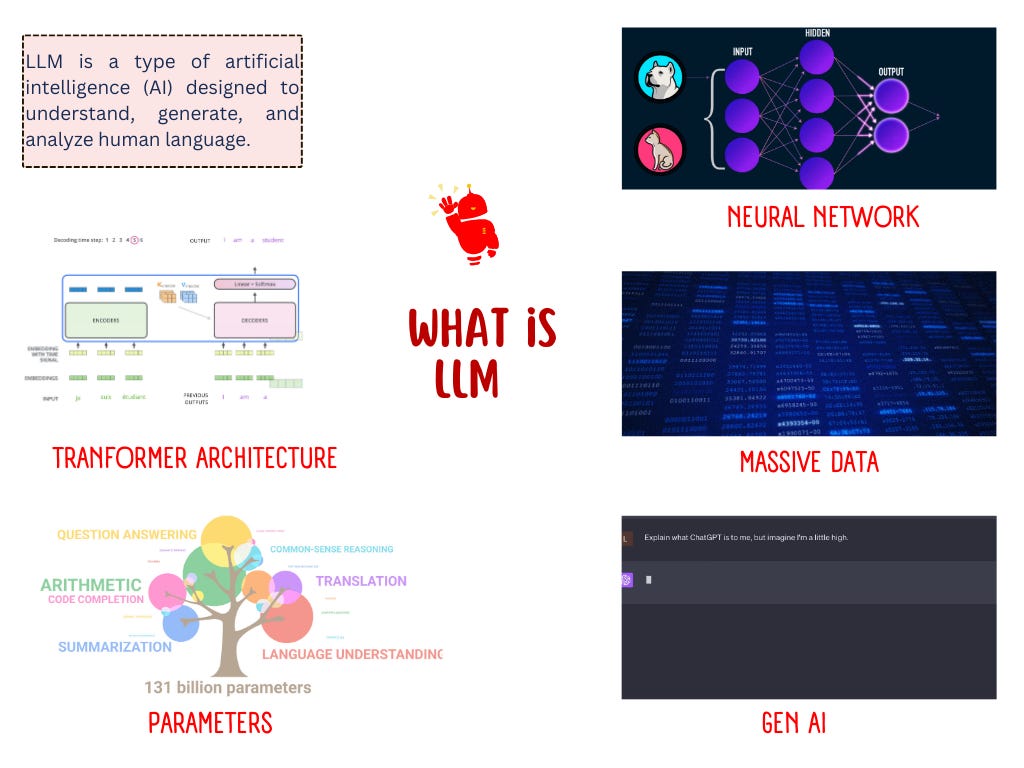
- LLM (Large Language Model): A model trained on vast amounts of text data (e.g., GPT).
- Token: A unit of data (e.g., a word or part of a word) processed by the AI.
- Fine-Tuning: Adapting a pre-trained model for specific tasks.
- Hallucination: When the AI generates incorrect or nonsensical information.
- Transformer: A neural network architecture used in models like GPT.
🌟 The Future of Gen AI
The possibilities are endless! From revolutionizing education to transforming entertainment, Gen AI is just getting started. But with great power comes great responsibility—ethical considerations like bias, privacy, and misinformation must be addressed as we move forward.
💼 Skills Required to Thrive in the Gen AI Era
As Gen AI becomes mainstream, here are the skills you’ll need to stay ahead:
1. Prompt Engineering: Crafting effective prompts to get the best results from AI models.
2. Data Literacy: Understanding how data is used to train and fine-tune AI models.
3. AI Ethics: Navigating the ethical implications of AI, such as bias and privacy concerns.
4. Domain Expertise: Combining AI knowledge with industry-specific skills (e.g., healthcare, finance, or design).
5. Collaboration: Working with AI as a partner to enhance creativity and productivity.
💬 Your Turn!
What’s your favorite Gen AI tool or use case? Reply to this email or tag us on social media with your thoughts. Let’s keep the conversation going!
Until next time, stay curious and keep innovating!
🚀 The Future is Generative. Are You Ready?
Hope you enjoyed reading this article.
If you found it valuable, hit a like and consider subscribing for more such content every week.
If you have any questions or suggestions, leave a comment.
This post is public so feel free to share it.
Subscribe for free to receive new articles every week.
Thanks for reading Rocky’s Newsletter ! Subscribe for free to receive new posts and support my work.
I actively post coding, system design and software engineering related content on
Spread the word and earn rewards!
If you enjoy my newsletter, share it with your friends and earn a one-on-one meeting with me when they subscribe. Let's grow the community together.
I hope you have a lovely day!
See you soon,
Rocky